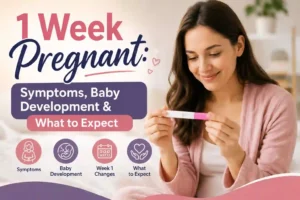
For a week 1 pregnancy, you are actually still on your period. Pregnancy Week 1 actually counts from the first day of your last period, before you have even conceived. Inevitably, signs such as cramping and fatigue arise — only these are connected with menstruation, not pregnancy.
When I initially saw “1 week pregnant” on a pregnancy app, I was totally confused. I hadn’t missed a period. “I didn’t feel pregnant. So there I was, supposedly a week pregnant. It took me a long time to understand how pregnant weeks are numbered like this, and once I did, it made so much more sense.
This article will cover what it truly means to be “1 week pregnant,” what’s happening inside your body, and what you can do right now to prepare for a future pregnancy.
What Does “1 Week Pregnant” Actually Mean?
How pregnancy weeks are calculated from your last menstrual period
And here is where most people get confused: technically, you’re not actually pregnant at 1 week.
Pregnancy is also dated from the first day of your last menstrual period ( LMP), not from the conception date. This method is what healthcare providers use, as it is a set day that can be tracked. Since ovulation — and thus conception — typically occurs around days 12 to 16 of a 28-day cycle, fertilization will not take place for up to one postnatal week or more.
What is the difference between gestational age and conception age?
Gestational age counts from your LMP. The age of gestation, however, dates from when conception took place. The two are usually separated by about fourteen days. So the next time your doctor tells you you’re 1-week pregnant, know that your body is actually still getting ready to ovulate. No embryo exists yet.
What Are the Symptoms at 1 Week Pregnant?
Any symptoms you have are probably symptoms of your period, and not pregnancy. While I was in this phase, I do remember feeling crampy and more exhausted than normal. I attributed it to my cycle—the very thing it was, after all.
Common symptoms during week 1 include:
- Mild cramping due to uterine contractions as the body sheds the uterine lining
- Menstrual bloating due to hormonal changes
- Hormonal fluctuations in estrogen and progesterone have been associated with shifting mood
- Feeling tired due to your body dealing with the physical demands of your period
- Breast tenderness, which is normal in the days prior to and during menstruation
None of these is good markers for pregnancy at this point. Nausea, smell sensitivity and a missed period—otherwise known as “true” pregnancy symptoms – usually don’t develop until weeks 4 to 6 at the earliest.
Is There a Baby at 1 Week Pregnant?
What is happening inside your body during week 1?
First week pregnant: No, there is no baby, or even an embryo. Your body is on its period and calming down from that hormonal storm before ovulation comes knocking in a couple of days.
Here’s how the timeline unfolds:
- Week 1: Menstrual phase- shedding of the uterine lining
- Around Day 14: Ovulation — release of a mature egg
- At this point, numerous sperm can fertilise the egg.
- Days 6–10 post-fertilisation: The fertilized egg implants within the wall of the uterus and forms an embryo
And fertilization is quite spectacular too in its own right. Sperm can survive in the female reproductive tract for up to five days, so mating two or more days before ovulation can still result in fertilization of the egg.
Can a pregnancy test detect pregnancy at 1 week?
For example, your body hasn’t even started making human chorionic gonadotropin (hCG)—the hormone pregnancy tests are looking for—at 1 week, since fertilization hasn’t even happened yet. At this stage in your cycle, you may be positive, and it would still read negative.
HCG levels don’t begin to rise until after implantation, which normally happens 6-10 days after ovulation. Home pregnancy tests usually detect hCG levels of 10 to 25 mIU/mL, which most women don’t attain until 10–14 days following ovulation.

When should I take a pregnancy test?
Positive tests are not recommended before your missed period (the first day of your period is 14 days after ovulation). Testing before then carries the emotional weight of the risk of receiving a false negative, which is misleading and not to mention painful to go through.
Your Body at 1 Week Pregnant: What’s Changing Hormonally?
Week 1: Your period is ending, and estrogen and progesterone levels are low. Follicle-stimulating hormone (FSH) rises progressively during the week and stimulates the maturation of the follicles in the ovaries.
Cervical mucus can also change. At the very beginning of the cycle, it is low and dry. The closer we get to ovulation, the clearer and slipperier it is — Think raw egg whites. This change indicates that your window of fertility is about to open.
What are the most important steps to take before conception?
If you are starting to plan a pregnancy or have just been told you could be pregnant, week 1 is actually the optimal time to start building those healthy habits. Most of those things I started prior to my positive test, and I am so glad I did!
- Begin a folic acid supplement: As stated by the CDC, women should eat 400 (µg) or more of folic acid on a daily basis starting in the month prior to conception to prevent neural tube defects.
- Follow a well-balanced diet: Focus on iron-rich foods (things like leafy greens and lentils), calcium-rich foods (dairy or fortified substitutes) and enough protein
- Take in a lot of fluids. Drink a minimum of 8 glasses of water daily
- Prioritise sleep: Slumber is essential for your body to regulate hormones appropriately.
- Medication Review: Consult your clinician first before using any prescription or over-the-counter medications during consideration for conception.
- Start taking prenatal vitamins: Get this into your system; many OBs recommend starting these before even a positive test.
Things to Avoid During Week 1
Some exposures are worth avoiding, even before a positive test:
- Alcohol: No known amount of alcohol is safe during pregnancy
- Smokers are at increased risk for miscarriage and fetal complications.
- Too much caffeine: Keep it below 200mg per day (around a single 12oz coffee)
- Raw or undercooked foods: Sushi, red meat and raw, untransformed products contain bacteria dangerous for an embryo in development;
- Unneeded medications — Always talk to a provider before trying anything
When Should You Get A Pregnancy Test?
So, wait until day 28 to 30 of an average 28-day cycle or the first day that you are late. Your urine is most concentrated with hCG in the morning, so the best result comes from your first-morning urine.
Negative results: If your period doesn’t appear after a few days, retest. Early tests can also give false negatives.
If your test is positive: Make an appointment with your OB or midwife. Most of these prenatal appointments are at eight to 10 weeks.
When To Call A Healthcare Professional?
Call a doctor or midwife if you feel:
- Severe abdominal or pelvic pain
- Unusually heavy or crash bleeding (greater than you will certainly normally have during a duration)
- Dizziness, fainting, or significant weakness
- Any symptoms that do not feel normal for your cycle
Frequently Asked Questions
Do I get pregnancy symptoms at 1 week pregnant?
Again, we could confuse period-related symptoms in the first week for pregnancy since we connect bad cramping, bloating and lethargy during that week as an indication that pregnancy has transpired. Pregnancy symptoms – including nausea and a missed period – don’t show up until week 4 or later, if they show up at all.
Is a 1-week pregnant test positive?
No. During week 1, no hCG is produced because fertilization has not yet taken place. A pregnancy test this early will always be negative.
What about a 1-week-pregnant baby?
Nope. Gestation is 1 week. There is no embryo or fetus at 1 week. Still in the menstrual phase. Usually only 1-2 weeks until ovulation.
What happens in the week of pregnancy?
This is when the uterine lining is lost. The body starts getting ready for ovulation. The next FSH starts to increase, so that the ovaries can start to make an egg.
Implantation at the first week of pregnancy — Can I feel it?
Nope. Implantation occurs about 6 to 10 days following ovulation, which is between weeks 3 to 4 of pregnancy, not week 1.
What to eat at 1 week pregnant?
Vitamin Folate or Folic Acid Iron Calcium Protein Omega-3 Fatty Acids Or lots of leafy greens, beans, whole grains, dairy or substitutes and lean protein.
Can I start taking prenatal vitamins at 1 week?
Yes. Prenatal vitamins should start before conception, if saving those early stages of fetal development requires more than what your body has available—particularly with folic acid!
When does pregnancy actually begin?
Medically measured from the last menstrual period. From a biological standpoint, it starts at the point of fertilisation, approximately 12 to 16 days into a usual 28-day cycle.
About The Author