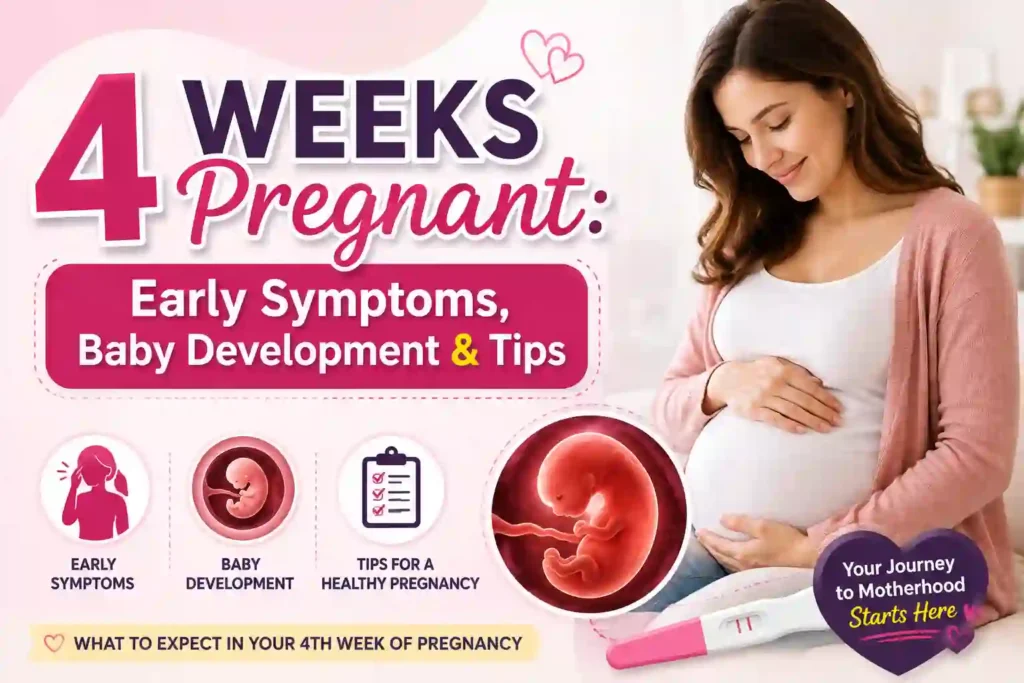
At 4 weeks pregnant, you’re at the beginning of your first trimester. You are at the stage of conception, your fertilized egg has placed itself into the uterus and pregnancy hormones start to rise. Symptoms may be mild or not present. A home pregnancy test can tell you if you are pregnant or not at this stage.
I recall seeing the second line of light and thought to myself, am I insane, is it the shine of a fresh dawn lighting on my skin? Four weeks pregnant is unreal; your body is generating a wonder within, yet externally nothing looks different at all. If you’re reading this because you just learned your test was positive (or you’re not sure yet), I want to say this: This guide is everything I wish I had when I stood exactly where you are.
Let’s review what’s going on in your body, what symptoms are normal, and what you should (and shouldn’t) do at this time to help set expectations for the week.
What Happens at 4 Weeks Pregnant?
Implantation and early pregnancy
Days 6–12 following fertilization: The egg (now a blastocyst) travels to your uterus and embeds in the uterine lining. This is implantation. Once it’s inside your body, it begins to release hCG, a hormone that instructs your ovaries to stop releasing more eggs and notifies the rest of your body that there’s a kid cooking.
Changes in pregnancy hormones
HCG Levels Double Around every 48–72 hours in early gestation. In addition to helping with hCG, progesterone goes up to prepare the uterine lining (and keep your period from coming). Changes in these hormones cause just about all the symptoms you may experience this week.
The beginning of embryo development
Around four weeks, the embryo is starting to form three layers of cells that will develop into organs and body systems; they are mostly called ectoderm, mesoderm, and endoderm.
4 Weeks Pregnant Symptoms
This can make 4-week symptoms easy to confuse with PMS. This was what I spotted — and what a lot of girls run into:
- Missed period — this is typically the first and most obvious symptom
- Light spotting or implantation bleeding — lasts 1–2 days of pinkish/brownish discharge
- Minor abdominal cramping – similar to period cramps from implantation
- Tender or sore breasts — one of the most common earliest symptoms
- Fatigue — progesterone can tire you out early
- Bloating — hormones are already slowing your digestive system down
- Changes in mood, as hormonal changes can sometimes mean emotional highs and lows
- Increased urination — blood flow is increased to the kidneys due to hCG
Nausea or morning sickness — starting as early as week 4 (more commonly from week 6 onward)
4 Weeks Pregnant Baby Development
How the embryo develops during week 4
At this point, the embryo consists of bilaminar layers of cells — the epiblast and hypoblast. These are about to become all of the tissues and organs your baby needs.
Formation of the amniotic sac and yolk sac
What to expect this week: Your amniotic sac—the pouch of liquid that will eventually protect your baby—starts forming this week. At the same time, you have a yolk sac, which gives nutrients to the embryo early on, before the placenta takes over.
Early development of the placenta
Trophoblasts — cells that will eventually form the placenta — are already sinking into the uterine wall, forming the arteries and veins that will nourish your sweet babe for all nine months.
Beginning of major organs and body structures
At the end of week 4, basic structures such as the brain, spinal cord, and heart, and major organs are only just becoming visible. It’s early — but already remarkable.
What Does a 4-Week-Pregnant Belly Look Like?
Honestly? Not much different from usual. No baby bump at 4 weeks. The embryo is the size of a dot, and your uterus has not grown much yet.
However, because progesterone levels are rising, your belly may feel a little puffier than it should (read: bloated). On average, most women don’t show until 12–16 weeks, and first-time moms even later!
What to Do at 4 Weeks Pregnant
This is the week to begin developing good habits. Here’s what I did — and what health care providers recommend:
- Begin prenatal vitamins — ideally a type that contains at least 400 mcg of folic acid, to help with the early formation of the neural tube
- Eat a healthy diet: consume plenty of folate-rich foods (leafy greens, legumes), lean proteins, whole grains, and dairy
- Drink lots of water — at least 8–10 glasses per day
- Fatigue is real, so be sure to rest at the times you need; do not fight it
- Exercise — Keep on moving; light-to-moderate intensity physical activity like walking or prenatal yoga is safe and good for you
Contact your OB before you are 8-10 weeks pregnant to schedule an appointment — if your OB is busy, just getting into the system will ensure that they can fit you in.
Foods and Things to Avoid During Week 4
Some things need to go — at least for the next 8 months. Avoid:
- Alcohol and smoking — no amount is safe during pregnancy
- Raw or undercooked meats, eggs and seafood — risk of listeria and salmonella
- Avoid high-mercury fish — shark, swordfish, king mackerel and tilefish
- Unpasteurized food — The risks of infection from soft cheeses, raw juice and unpasteurized dairy
- Some medicines — check with your doctor before taking anything, including over-the-counter drugs
- Caffeine — consumption that is too high, as a large number of advisory guidelines suggest being below 200 mg per day (roughly one cup of espresso)
When Should You Take a Pregnancy Test?
Can you get a positive pregnancy test at 4 weeks?
Yes. hCG levels are typically within the range detectable by a regular home pregnancy test by 4 weeks. Test with first-morning urine, which is the most concentrated, for a more precise result.
How accurate is a home pregnancy test at 4 weeks?
The American Pregnancy Association explains that most home pregnancy tests are greater than 99 percent accurate when taken after a missed period.
What if the test is negative but your period is late?
Either your hCG levels are rising slowly or it is just a little too early. Wait 2–3 days and test again. Contact your doctor if your period hasn’t started by now and your tests are still negative.
When to Call Your Doctor at 4 Weeks Pregnant
Most early symptoms are normal. But if you have any of the following:
- Very heavy bleeding (heavier than a normal period)
- Severe abdominal or pelvic pain
- One-sided or sharp pain may mean ectopic pregnancy
- Dizziness or fainting
- Fever above 100.4°F (38°C)
- Trust your instincts. If something feels off, call.
About The Author