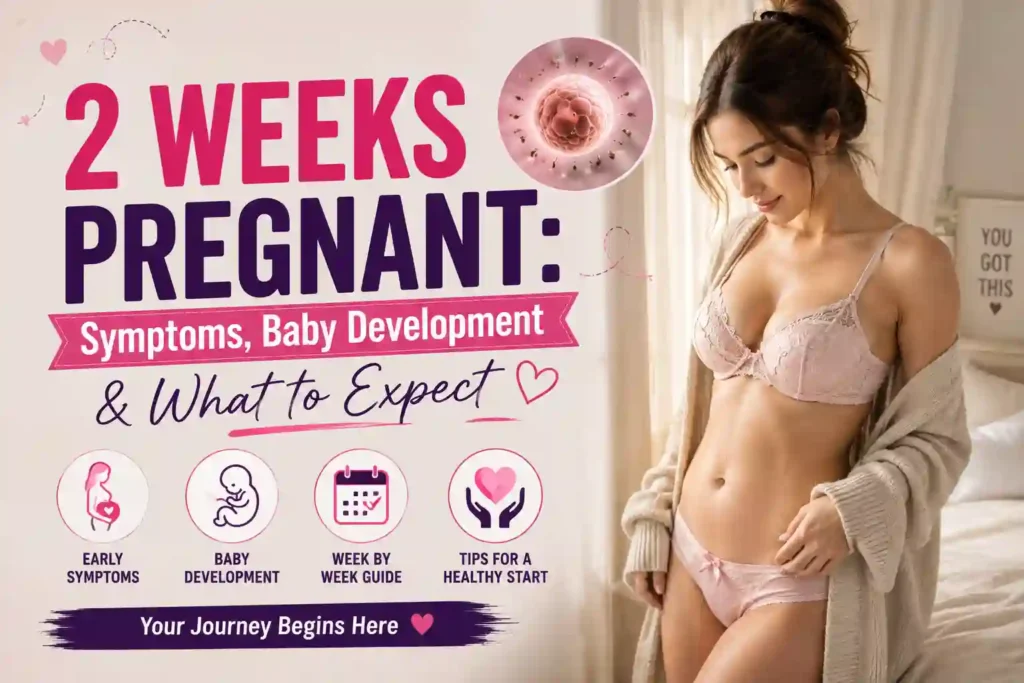
At 2 weeks pregnant, you may technically be ovulating rather than actually pregnant. Pregnancy starts from the first day of your last period, so doctors consider that conception can occur in week 2! Do not sit in; there is no baby yet, no bump, and the test will be useless. The Symptoms You Experience Now Are Usually Ovulation, Not Pregnancy
During my quest to have a baby, “2 weeks pregnant” was more confusing than any other phrase. I still distinctly recall examining a pregnancy application and analysing how I may be two weeks pregnant if I hadn’t had sex near this period in any respect. If that sounds like you, take a breath—you’re not wrong, and there are really strange math things happening.
This post will walk you through what week 2 really is, what’s going on with your body, which symptoms are real vs. wishful thinking, and the wise actions to take right now. I went through this exact phase, so I’ll share what helped me, along with the medical facts.
Before that, let us first get rid of the confusion.
What Does 2 Weeks Pregnant Even Mean?
Now we will get to the part almost nobody tells you: by 2 weeks, you’re not really pregnant yet.
Diagnosis of pregnancy is not done by the date when you conceive; your pregnancy count starts from the first day of your last menstrual period (LMP). This is termed gestational age, and health care providers use it because most people can easily tell when their last period started, but very few know exactly when they conceived.
Week 1: You are on your period: no egg, no sperm, no baby.
Week 2: The body is preparing to ovulate. Likely conception occurs in the very last week of the week.
Week 3: Most often, fertilisation and the first few stages of cell division.
So, “2 weeks pregnant” measures time since conception, not a record of it. This was strangely comforting when it clicked—at least I wasn’t missing anything or behind on the symptoms. There weren’t any yet.
What Happens at 2 Weeks Pregnant?
Around day 14 of a normal 28-day cycle, one of your ovaries sends out its mature egg — energised by hormones. This is ovulation. The egg travels from there down the fallopian tube, where it lives for about 12 to 24 hours. But sperm can live in the reproductive tract up to five days. And if you’re wondering why your fertile window lasts a few days, not just the single day you ovulate.
Fertilisation can take place if sperm meet the egg within this timeframe. This typically occurs in the latter part of week 2 or early week 3. Then a zygote, a fertilised single cell, forms and starts dividing as it travels towards the uterus.
Two weeks is when the “action” is well and truly at a cellular level (if any).
2 Weeks Pregnant Symptoms: What You Might Actually Notice
Honestly, no—not pregnancy symptoms. All that you might notice are ovulation signs that can be mistaken for early pregnancy.
- Some people experience around ovulation:
- Mild lower abdominal cramps on one side (mittelschmerz)
- A day with mild bloating or a sense of a fuller stomach
- Clearer and more stretchable vaginal discharge (like raw egg whites)
- Hormonal changes cause breast discomfort
- Estrogen Increases Mood Changes
- And with this enhanced sex drive comes the lovely natural timing.
I documented all of these obsessively for months thereafter, believing every twinge was significant. These are symptoms that your body is ovulating (not that an embryo has implanted).
Can You Feel Pregnant at 2 Weeks?
No, you cannot feel conception occurring, and no, you are not pregnant at 2 weeks.
Fertilisation is invisible and painless. At this point, the fertilised egg—which is smaller than a grain of sand—has yet to enter the uterus. No hormonal tidal wave is that great to create all the classic symptoms 2-4 weeks into pregnancy.
You may start to see the first signs of early pregnancy by 5 to 6 weeks, when hCG (the pregnancy hormone) begins to increase in your body after implantation. If you think you’re noticing something unusual at week 2, it is much more likely ovulation or just expectation. Trust me, I know what I am talking about — having told myself for days before it was even possible that I felt pregnant.
2 Weeks Pregnant Belly: Is There a Bump?
If your gut looks a little rounder and/or feels too tight, that’s often swelling—usually due to hormonal changes around ovulation or digestion. We don’t have an embryo occupying that space yet.
In general, your bump won’t be visible until the second trimester, between weeks 12 and 16 for first pregnancies (and sometimes earlier for later pregnancies). So this week, pay no attention to the waistband.
Can You Take a Positive Pregnancy Test at 2 Weeks?
Unfortunately, 2 weeks is too early to get an accurate pregnancy test result!
Most home pregnancy tests measure the hormone hCG, which our body only produces after a fertilised egg has attached itself to the wall of your uterus. In the 2nd week after ovulation, no hCG is secreted yet because implantation has not occurred.
This is the advice I should have started following earlier:
- The most accurate result is after your missed period.
- Test first thing in the morning, when hCG is at its highest.
- Testing too soon is almost always a false negative and adds stress for no reason.
In the first few weeks of pregnancy, hCG levels roughly double every 48 to 72 hours, so just a couple more days’ patience makes a huge difference to how accurate your result will be.
2 Weeks Pregnant but Negative Pregnancy Test
A negative test at 2 weeks is expected—it doesn’t mean you can’t be pregnant.
The reasons are simple:
- You tested before implantation, so hCG hasn’t even been released yet.
- Ovulation occurred later in your cycle than would be expected.
- It’s simply far too early.
Test, but not before at least the date your period is due. However, if your period is not normal and tests continue to return negative after one week (or later), it may help to make an appointment with the healthcare provider to exclude other causes.
2 Weeks Pregnant Discharge: What’s Normal?
An increase at 2 weeks is normal and linked to ovulation.
In the days leading up to your fertile window, cervical mucus becomes clear, slippery, and stretchy like raw egg white. This texture helps sperm travel. It typically gets thicker and whiter post-ovulation.
Clear and white discharge is usually perfectly healthy. If discharge is green or yellow, clumpy like cottage cheese, or accompanied by itching, burning, or odour, see a doctor, as these can signal an infection.
2 Weeks Pregnant Cramping: Is It Normal?
It can be mild and painless, but some intermittent activity at 2 weeks is common.
Most women have experienced ovulation cramps, a dull ache or twinge they feel on one side of the lower abdomen. This may last several minutes, or the symptoms do not go away for two days.
Can implantation occur within the second week?
Not quite. This is why implantation usually doesn’t occur until at least about 6 to 12 days after ovulation- around week 3 or even 4. This means that your current cramps are almost always ovulation-related.
Call for emergency care if you have severe, stabbing, or continuous pain and bleeding, fainting or dizziness, or shoulder pain.
Foods to Eat and Avoid at 2 Weeks Pregnant
Nourishing your body now is the first step in building a solid foundation.
Foods to prioritise:
- Dark green leafy vegetables (broccoli, asparagus)*
- Folic Acid: You are Brought for Data Up to Oct 2023
- Lean protein, eggs, and beans
- Whole grains, fruits, and a lot of vegetables
- Calcium in dairy or fortified alternatives
What to eat less of or avoid entirely
- Alcohol
- Those at the top of your food chain and high in mercury levels would be shark, swordfish, and king mackerel
- Meat, eggs and seafood that are raw or undercooked
- Unpasteurized dairy and soft cheeses
- High caffeine (stay below around 200 mg daily)
The earliest weeks of development, before you’d ever know to change anything, make healthy habits matter even before a positive test.
Frequently Asked Questions About 2 Weeks Pregnant
Is 2 weeks pregnant actually pregnant?
Usually not. Pregnancy begins 2 weeks after the start of your last menstrual period, so at the end of week 2 you’re ovulating, not pregnant. It was around week 2 or the start of week 3 when conception happens.
Can you have pregnancy symptoms at 2 weeks?
Not true pregnancy symptoms. Almost everything you feel — cramping, bloating or discharge — is related to ovulation because pregnancy hormones have not yet risen.
Can you feel implantation at 2 weeks?
Implantation occurs 6-12 days after ovulation, which is at weeks 3 or 4 – thus no. Feelings in the second week are usually associated with ovulation.
Should I start taking prenatal vitamins at 2 weeks?
Yes. Taking a prenatal vitamin with 400 mcg of folic acid before you get pregnant supports healthy development in the very early stages of pregnancy.
How many weeks pregnant are you when conception occurs?
When you conceive, you are 2 to 3 weeks pregnant. This is because pregnancy due dates are calculated based on your previous period (not on when fertilization actually occurs).
About The Author